How long do you have to wait for hot water?
Let's do a quick run-down of how a traditional water tank heating system works. Cold water is fed into your tank from your supplier (city supply or well). Inside the water tank are some heating elements that heat the water to the temperature that your thermastat is set for. Another line leaves the water tank and supplies your home with hot water. This line traditionally is a one-way line meaning that it leaves the tank and runs through the home and eventually dead-ends. See digram below. Each time a faucet is opened, water exits the faucet and more is pushed in from the water tank end (which is hot). If the faucet hasn't been used in a while, the water coming out is cold because it has been sitting in the pipe with nowhere to go. Now, you have to wait for the cold water to run out (and down the drain) before the water eventually becomes warm/hot.
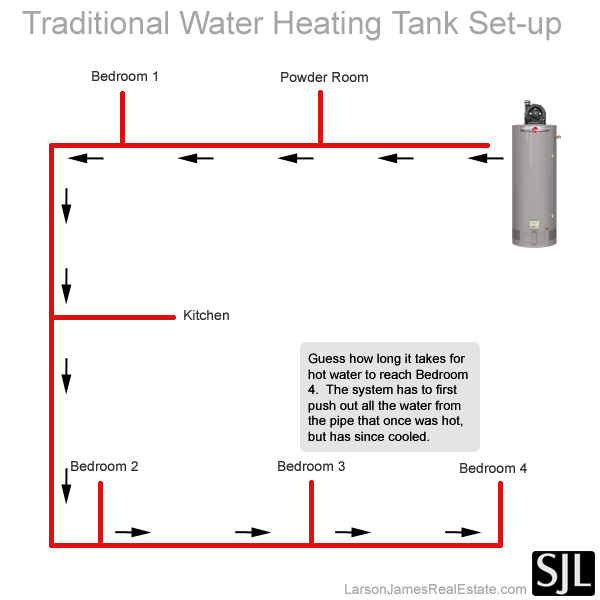
This has been the common method for many years. For those who have ever lived in a ranch style home, you know that the distance from the water heater to the end of the line (often the opposite end of the home) can be quite long. The water remaining in the line after use eventually cools, so the next time you turn on the hot water at the far end of the home, the system has to first push out all that (now cold) water before you receive any hot water. That cold water is now wasted water that goes down the drain.
What is Circulating Hot Water?
Have you ever wondered why when you're at a hotel of 100 rooms, the hot water comes out almost immdiately, but at your 4 bedroom home, you wait for possibly minutes? Here's why. Remember above when I mentioned that your system has to push out all the old hot water (now cold) before you receive hot? The amount of that depends on the length of the pipe run from your water tank to the outlet you're opening up. In the case of a hotel, they shorten that distance by virtually moving the hot water source closer to the faucets. What", you say. They put hot water tanks all over the hotel. Well, that would be one way, but here's another. Instead, the main source generating the hot water may be in one or several locations, but they continuously pump that hot water through a loop pipe (circulating). Then, short runs of pipe are connected from the loop to the faucets. The result is that when you turn on a faucet, only a short pipe's worth of cold water (previously hot) has to be pushed out. The delivery of hot water time is reduced from possibly minutes down to just seconds. See diagram below.

Using the ciculating hot water method, the dead-ended route is turned into a loop and a small circulating pump is installed the continuously pushes hot water through the loop. The connections from the loop to the faucets are then short runs - often just a few feet, so when you turn on any faucet wanting hot water, you are only waiting literally a few seconds.
Well, that's what circulating hot water is. Once you've used it, it's hard to go any other route (in my opinion). Even with the newer tankless systems, the hot water still starts at the location of your heating unit, to that's still using more of a traditional system that has to push out all the cold water from the pipes before you receive hot.
Check it all out and make the decision about what's best for you. To learn more about tankless water heater systems, here's a link.


